themanintheseersuckersuit wrote:To cite a 1995 award for ozone chemistry in a thread on CO2 is a bit of bait and switch.
I agree, and I noted that the connection is not that significant above, although I don't think bait and switch was the intention.
themanintheseersuckersuit wrote:I don't think the predictions about the ozone layer have been born out over time.
The chemistry of ozone depletion by CFC's and other chemicals is not seriously disputed by anyone. The once accelerating rate of ozone loss has slowed down gradually, though it is still unpredictable from year to year, and most believe this is a direct response to limits on CFCs, and a shining example of a smart international public policy decision.
themanintheseersuckersuit wrote:Water vapor is relevant given the iris effect.
You might want to explain the iris effect for interested readers. I don't think even Richard Lindzen is as enthusiastic about it as he once was. And no one is saying water is irrelevant to the greenhouse effect, just that it can't be the ultimate cause of any observed atmospheric warming.
themanintheseersuckersuit wrote:An none of this predicts the historical or recent trends in temperature. We're still talking about danger that only exist in computer models.
Not sure what you mean by the first sentence. A rise in temperature over historical and recent timescales (not geologic ones - see below) is predicted by the observed increase in CO2. Unfortunately we can't reproduce the whole atmosphere in a lab, so computer modelling is essential to the predictions, but as I said I don't think you are really qualified to assess the models or tell atmospheric scientists that their work is bullshit.
themanintheseersuckersuit wrote:And lets not forget that a Nobel prize was awarded for ice pick lobotomys.
Again, I don't think anyone seriously disputes that Rowland and Molina, and Crutzen's Nobel Prize was well-deserved.
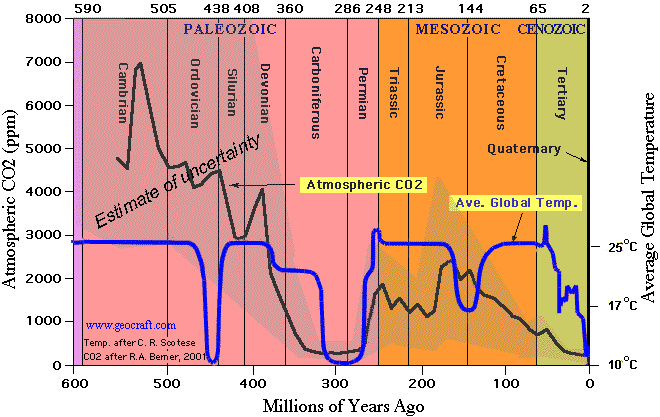
themanintheseersuckersuit wrote:CO2 concentrations have been higher in the past in times when life on Earth thrived. Plants evolved in times when co2 was higher. Current co2 concentrations are near long term historical lows. Where did all that coal and oil come from?
It's true that life thrived on Earth in the past, and CO2 then was much higher. I don't dispute the data in the graph below, although determinations of both CO2 concentrations and temperatures from that long ago have very high levels of uncertainty. The graph makes it clear that the carbon in coal and oil dating from the Carboniferous was taken from the gradual decline of CO2 from prior levels.
The important point is the timescale of the graph is in hundreds of millions of years. Life thrived because it had millions of years to adapt to the changes. What's more, on that timescale, there is little connection between CO2 and temperature because CO2 levels are determined by slow geologic processes like weathering of carbon containing rocks, geologic uplift, and volcanism, and temperature is largely determined by variations in the Earth's orbit. The graph is almost totally irrelevant to the argument (you could say it's a bit of a bait and switch itself) about anthropogenic greenhouse warming because the relevant timescale there is hundreds of years, not hundreds of millions.
[/quote]


 --Bob
--Bob


 I may try to read the whole thing when I'm not so tired.
